

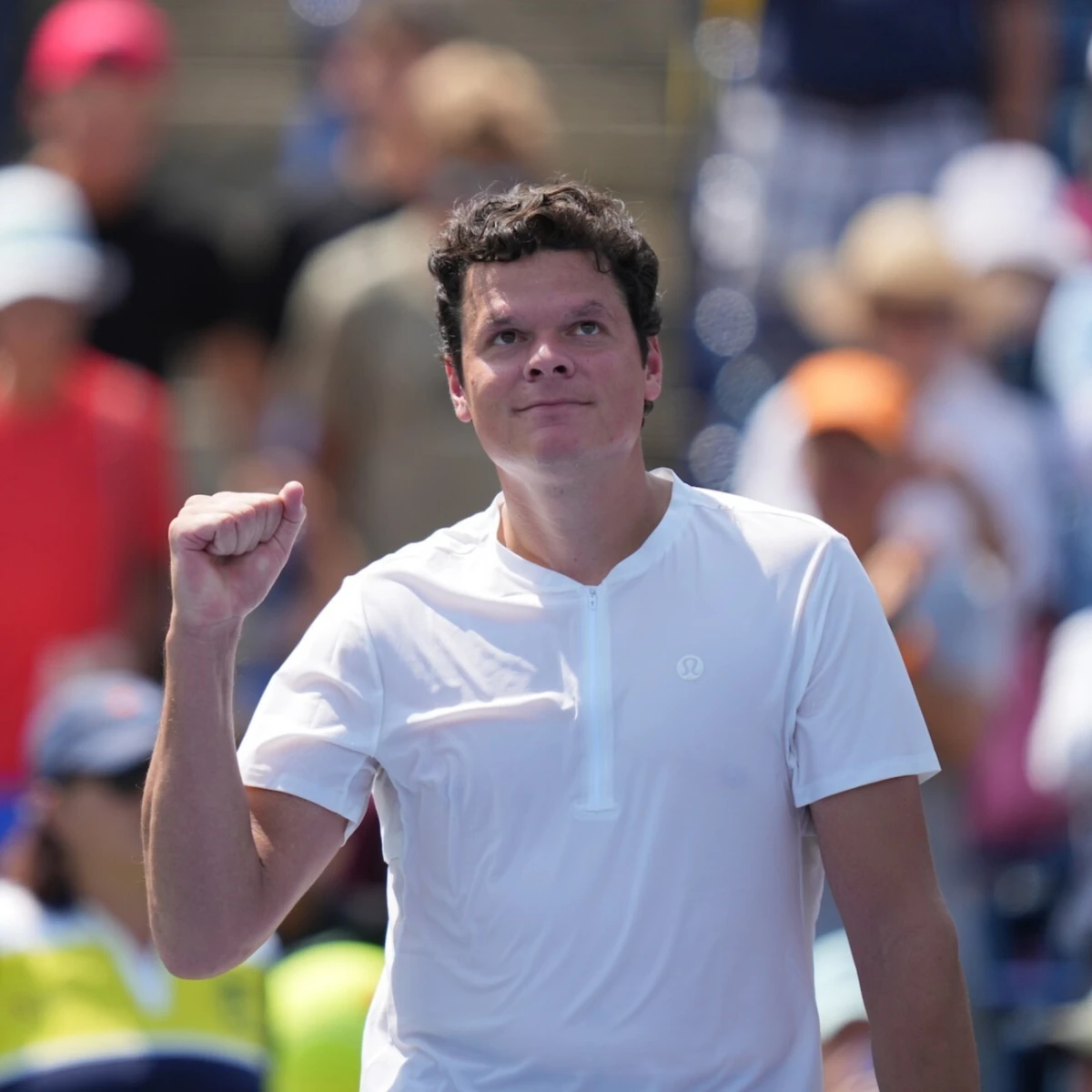
On Sunday, January 11, on social media, Canadian tennis icon Milos Raonic delivered the news that many had been expecting, but still few were likely emotionally ready for. The former world No. 3 and Wimbledon runner-up announced he was hanging up his racquet for good.
Over his 18-year career, Raonic rewrote the Canadian tennis record books and forever changed the landscape of the sport in this country.
In honour of the Missile from Thornhill, let’s take a look back and celebrate his groundbreaking career.
Breakthrough and Record Smasher
In October 2010, world No. 1 Rafael Nadal secured what looked to be a routine second-round victory at the Japan Open in Tokyo over a 19-year-old from a country not known for producing great singles players.
But Nadal, coming down the home stretch of one of the best seasons in tennis history, was impressed by his young opponent, particularly his most devastating weapon.
“You can't compare big servers, everyone has their own serve, but his is unbelievable. I think he will rise in the rankings,” said Nadal of Milos Raonic. “Tennis seems to be getting better and better in Canada, they have some important ATP and WTA events. I'm sure he will improve fast."
Rafa was right. And it did not take long for his prediction to come true.
Just three months after the clash in Tokyo, Raonic was no longer an unknown following his breakthrough run at the Australian Open. In just his second Grand Slam main draw, the 20-year-old rode his huge serve into the fourth round, taking out world No. 10 Mikhail Youzhny in round three, and even got the first set against No. 7 David Ferrer before bowing out. Suddenly, Raonic was the talk of the sports scene in Canada.
Read also: Milos Raonic Gets His Flowers After Retirement Announcement - Reaction Roundup
A month later, he was hoisting his first ATP Tour trophy. Raonic did not drop a set that February in San Jose, at a tournament fittingly hosted in a hockey rink, securing the first tour-level singles title by a Canadian man since 1995 by scoring another Top 10 win, this time over Fernandez Verdasco. That venue in San Jose became Raonic’s personal kingdom, as he won three straight titles in the SAP Centre from 2011 to 2013 before the tournament was sold and relocated.
That spring, Raonic, still only 20, became the highest-ranked Canadian male singles player of all-time. He was the first Canadian man to crack the Top 30 in April, reached a high of No. 25 in June, and finished the year at No. 31, the best year-end finish by a Canadian man.
The following year, Raonic reached four more ATP Tour finals, adding two titles to his career haul. He continued his assault on the rankings record, reaching a new career-high of No. 13 in November. The Canadian also found himself more frequently meeting the tour's best players in 2012, including a pair of victories over a man who would later become one of his greatest foes, Top 4 mainstay Andy Murray.
Read also: Rob Shaw to retire from professional tennis after the Australian Open
In 2013, Raonic put Canadian tennis on the map like never before. On home soil at the National Bank Open in Montreal, he became the first Canadian man in the Open Era to reach the final. In the process, he entered the Top 10 in the ATP rankings for the first time. He also guided Team Canada to its first Davis Cup semifinal in a century with wins over Spain and Italy before narrowly being edged out 3-2 by the Novak Djokovic-led Serbia.
A year later, the Canadian flag was again central in Raonic’s accomplishments, as he literally carried it on court in the United States capital. That July, Raonic defeated countryman Vasek Pospisil in, what is still as of January 2026, the only all-Canadian final on the ATP Tour. At the ATP 500 level, it also proved to be the biggest title of Raonic’s career. The victory came just weeks after Raonic became the first Canadian man to reach the singles semifinals of a Grand Slam at Wimbledon, losing to then-seven-time champion Roger Federer.
At season’s end, the Thornhillian reached his second Masters 1000 final in Paris, beating Federer for the first time in the quarter-finals, which helped him become the first Canadian man to qualify in singles for the ATP Finals.
2016 Season and Wimbledon Final
After an injury-plagued back half of 2015, Raonic came out fresh and ready to dominate in 2016. He sent a message in his first tournament of the year, defeating Federer to win the Brisbane International. In Melbourne, Raonic kept rolling, powering his way to the Australian Open semifinals on a run that included wins over Gael Monfils and 2014 champion Stan Wawrinka.
In the semis, he was in control and outplaying Murray, leading two sets to one, when he suffered a thigh injury. Visibly hobbled, Raonic could not close out the match, falling agonizingly short of a first major final.
Luckily, the injury did not affect him too badly and he was able to return at the first Masters 1000 event of the year in Indian Wells, where he reached the final (losing to Djokovic). Raonic reached the quarter-finals or better at his first six tournaments in 2016, including the Australian Open and the first four Masters 1000 events.
But the lawns of England were where Raonic really hit his stride. Playing textbook grass-court tennis and with three-time Wimbledon champion John McEnroe in his coaching box, he powered his way to his first final on the surface at the Queen’s Club and led Murray by a set and a break, only for the Scot to mount a furious comeback.
Read also: Eugenie Bouchard’s Farewell to Tennis in her own Words
After that final, Raonic quipped in his on-court interview that he wanted a rematch in a few Sundays’ time, referring to the Wimbledon final. He would get his wish.
At the All-England Club, the Canuck did not drop a set on his way to the fourth round, where he mounted the first and only comeback from two sets down in his career to defeat David Goffin and reach the quarter-finals, where he overpowered Sam Querrey to reach his second Wimbledon semifinal.
Like 2014, Federer was waiting. This time, though, the Canadian came up clutch when it mattered most. Raonic rallied from two-sets-to-one down, breaking late in the fourth to send the match to a decider, where he delivered a serving masterclass to defeat the winningest player in Wimbledon history and become the first Canadian man to reach a Grand Slam singles final.
As was the trend in 2016, Murray spoiled Raonic’s party, denying Canada its first Grand Slam singles champion in three tight sets. There was just one break of serve in the match.
Read also: Alcaraz, Sinner, Swiatek going for history in 2026
Raonic was solid down the stretch, reaching three further semifinals, two of them at the Masters 1000 level, and qualifying for the ATP Finals for a second time. Group-stage wins over Dominic Thiem and Monfils propelled the Canadian into the semifinals, making him the first Canuck to reach the final four in singles at the year-end championships.
His semifinal clash with Murray was one of the matches of the year. It lasted three hours and 38 minutes and was decided in an epic third-set tiebreak where both men held match points. Once again, though, it was Murray scoring the win, claiming the thriller 5-7, 7-6(5), 7-6(6).
The silver lining was that just by reaching the semifinals in London, Raonic finished the year at a career-high ranking of No. 3 in the world, the highest singles ranking ever achieved by a Canadian, male or female.
Last Stand
The final years of Raonic’s career saw injuries truly start to take their toll and limit the amount of time the Canadian was able to spend on court. From the beginning of 2019 to his final appearance on tour in 2024, he only played 100 matches total. That included appearances in just eight of a possible 22 Grand Slam main draws and 10 of 43 Masters 1000s.
However, when he was able to play, the veteran still managed to make an impact.
In those final eight majors, he reached the quarter-finals twice, both at the Australian Open in 2019 and 2020, as well as two round-of-16 showings (Wimbledon 2019 and Australian Open 2021). He also reached his fourth Masters 1000 final at the Cincinnati Open (held in New York) in 2020, which was the closest he came to claiming a 1000-level title when he took the first set against Djokovic.
His final match win on the ATP Tour was one for the ages. In the first round of the 2024 Queen’s Club Championships, Raonic blasted 47 aces past Brit Cameron Norrie, a record for a best-of-three match.
The last match of Raonic’s career came in July 2024 at the Summer Olympics in Paris, a three-tiebreak loss to Dominik Koepfer.
Legacy
At the time of his retirement, Raonic holds practically every record for a Canadian singles player, particularly men’s records.
His career-high ranking of No. 3 is the best a Canadian singles player has ever been ranked, male or female. His eight singles titles are also a record among Canadians, although Félix Auger-Aliassime tied it in October 2025.
Raonic’s career at Grand Slams is unparalleled for a Canadian singles player. He was the first Canadian man ever to reach the quarter-finals of a major and the first to reach at least the round of sixteen at all four majors (also since matched by Auger-Aliassime). The Thornhillian is currently the only Canadian, male or female, to reach the quarter-finals of a major on all three surfaces.
His 10 Grand Slam quarter-finals and three semifinals are Canadian records and he is still the only Canadian man to reach a Grand Slam singles final.
Looking beyond Canada, Raonic’s serve will go down as one of the best in history. He currently sits ninth all-time in aces with 8,445. He averaged 15.5 aces per match across 542 matches in his career, the fewest number of matches played among the Top 18 on the all-time ace list. His serve was so good that Djokovic, one of the greatest returners of all time, once said he never felt so helpless on return as he did after playing Raonic in Rome in 2014.
When it comes to evaluating Milos Raonic’s importance in the history of Canadian tennis, it is very simple. The sport would not be what it is today in this country without him. His records may eventually fall, some of his results have been surpassed, but he will always be one of, if not the most impactful Canadian tennis player of all-time.
The Davis Cup returns to Canada in February as Canada hosts Brazil in the Qualifiers First Round in Vancouver, Feb. 6-7 at UBC's Doug Mitchell Thunderbird Sports Centre. Tickets are on sale. Get yours now!
Feature Photo: Peter Power